How to Be a Bookie in College: The Side Hustle No One Talks About
Let’s be real for a second. The “college experience” is expensive. Between tuition, textbooks that cost more than a used car, and the social pressure to actually have a life on weekends, the average student bank account is usually hovering somewhere between “zero” and “panic.”
You see the standard advice everywhere: “Drive for Uber,” “Donate plasma,” “Work at the campus library for minimum wage.”
But there is another economy running quietly on almost every campus in the world. It’s happening in the fraternity houses, the dorm lounges, and the sports bars on Saturday afternoons. It’s the sports betting economy. And while thousands of students are losing money betting on parlays every weekend, a select few are sitting on the other side of the counter, collecting the juice.
If you are Googling “how to become a bookie in college,” you are already thinking differently than 99% of your peers. You aren’t looking for a job; you are looking for a business.
This isn’t a guide on how to be a sketchball in a trench coat. This is a breakdown of how to run a modern, professional, technology-driven sportsbook right from your dorm room using platforms like Bookie Software.
Why College is the Perfect Incubator for Bookies
Before we get into the “how,” we need to talk about the “why.” Why is a university campus the single best place on earth to launch a bookie business?
1. The Density of the Market
In the real world, finding customers is hard. You have to buy ads, run SEO campaigns, and cold call. In college? Your customers are your roommates. They are in your Econ 101 class. They are at the tailgate. You are surrounded by thousands of people in your exact demographic—young males (mostly), obsessed with sports, with disposable income and a high risk tolerance.
2. The Social Network Effect
Word of mouth on a college campus moves faster than fiber optic internet. If you run a solid operation—you pay fast, your site works well, and you’re a good guy—your reputation will spread instantly. You don’t need a marketing budget; you just need to be social.
3. The Tech-Native Advantage
Your “competition” in the real world might be some old-school guy writing bets on paper. In college, your players expect a digital experience. They want to bet on their iPhones while sitting in a lecture. Because you are a digital native, adopting modern tools like Bookie.Software comes naturally to you, giving you an instant edge.
The Reality Check: Is This Legal?
We have to address the elephant in the room immediately. Is this legal?
The honest answer: It depends entirely on where you are. In the United States, sports betting laws are a patchwork quilt. Some states are fully legal and regulated; others are strict. In some places, being a “social bookie” among friends is a grey area; in others, it’s a felony.
The Golden Rule: Do not take advice from a blog post (even this one) as legal counsel. Know the laws in your specific jurisdiction. This article is for educational and entertainment purposes. If you proceed, you do so at your own risk.
However, many students operate by following the “Fight Club” rules: You don’t talk about it to people you don’t trust, you keep your operation tight, and you don’t flash cash.
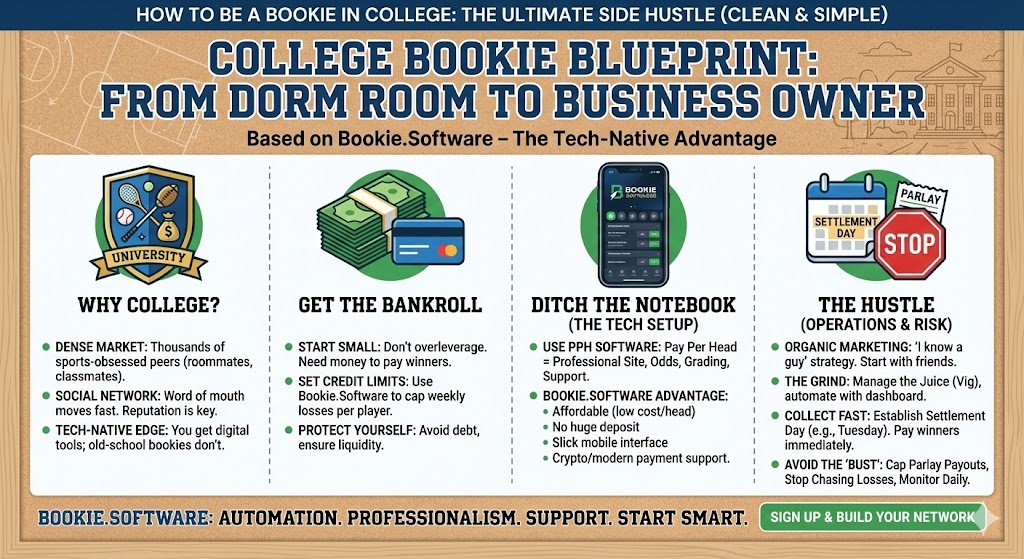
Step 1: The Bankroll (You Need Money to Make Money)
The biggest misconception about becoming a bookie is that you just collect money. Wrong. You have to pay money when players win.
If your roommate bets $100 on the underdog to win $150, and the underdog wins, you need to have that $150 ready to hand over immediately. If you tell him, “Uh, wait until my financial aid check clears,” you are out of business.
The Student Strategy: Start small. Do not take a $1,000 bet if you only have $500 to your name.
- Set Credit Limits: This is your safety valve. On platforms like Bookie.Software, you can set a “Weekly Credit Limit” for every player. If a guy only has $50 a week to lose, set his limit to $50. He literally cannot bet more than that. This protects him from debt and protects you from bankruptcy.
Step 2: Ditch the Notebook (The Tech Setup)
If you are writing bets on a piece of paper or tracking them in an Excel spreadsheet, stop. You will make a math error, or you will lose the paper, or you will miss a line movement and get crushed.
You need a Pay Per Head Sportsbook Software (PPH) service.
What is Pay Per Head?
It’s simple. You partner with a company that has already built a massive, professional sportsbook website (like DraftKings or FanDuel).
- They provide the odds (lines).
- They provide the website and mobile app.
- They grade the bets (win/loss).
- They handle the customer service.
You don’t pay them a percentage of your profit. You pay them a flat weekly fee for every player who places a bet.
Why Bookie.Software is the Student’s Best Friend
Most PPH services are built for old guys with massive bankrolls. They are clunky, expensive, and require a minimum deposit of $500 just to start.
Bookie.Software disrupts this model, making it perfect for the college entrepreneur:
- Affordability: The cost per head is incredibly low. If you have 10 players, your overhead is the price of a couple of pizzas.
- No Bulky Deposits: You can start with a very low barrier to entry.
- Mobile First: The interface is slick. When your frat brother pulls up your site on his phone, it looks professional. It doesn’t look like a shady 1990s website.
- Crypto & Automation: Managing cash on campus can be sketchy. Bookie.Software supports modern payment tracking, allowing you to settle up using the methods students actually use (CashApp, Venmo, Crypto).
Step 3: Acquiring Your First Players (The “Soft” Launch)
Do not print flyers. Do not post on your Instagram story “Hey guys, taking bets now!” That is how you get expelled or arrested.
Your marketing must be organic and whisper-quiet.
The “I Know a Guy” Strategy: You are watching the game in the common room. Someone says, “Man, I wish I could bet on this game, but the apps are geo-blocked/I don’t have an account.” That is your cue. “I use this site, Bookie.Software. It’s pretty solid, I can get you an account if you want.”
You aren’t selling; you are solving a problem.
Start with your inner circle—your 5 closest friends. These are people you trust to pay you when they lose. Once they get used to the platform, they will ask, “Hey, can my roommate get an account?”
Scaling Up:
- The Fraternities: If you are in Greek life, this is a goldmine. One house can sustain an entire bookie business.
- The Intramural Leagues: People who play sports usually bet on sports.
- The “Sharp” Warning: Be careful recruiting Math or Stats majors. They might actually be good at betting. Ideally, you want “squares”—people who bet with their heart (e.g., “I’m betting on State because I go there!”). Squares are profitable. Sharps are dangerous.
Step 4: The Grind (Management and Discipline)
This is where the “passive income” myth dies. Being a bookie is work.
Managing the Juice (The Vigorish)
Here is how you actually make money. Standard betting lines are -110. This means a player bets $110 to win $100.
- If Player A bets $110 on the Giants and loses, you keep $110.
- If Player B bets $110 on the Eagles and wins, you pay him $100.
- You have $10 profit left over.
That $10 is the “vig” or “juice.” Over hundreds of bets, that math guarantees the house wins, as long as the action is balanced.
Bookie.Software gives you a dashboard where you can see this balance in real-time. If everyone on campus is betting on the home team, you might need to “move the line” to encourage people to bet on the other side. The software makes this easy.
The Collection Cycle
In college, nobody has cash on Tuesday. Everyone has cash on Friday (payday) or Monday (allowance). Establish a strict Settlement Day. Tuesday is standard in the industry.
- Tuesday Morning: You log into Bookie.Software. You pull the “Agent Report.” It tells you exactly who is up and who is down.
- Tuesday Afternoon: You send the texts. “Hey man, you’re down 50.” or “Nice week, I’ve got your 100.”
- The Golden Rule of Collections: PAY FAST. If a player wins, pay them immediately. The faster you pay, the more they trust you. The more they trust you, the more they bet. If a player owes you, give them a reasonable deadline, but do not let them bet again until they settle up.
Step 5: Avoiding the “Bust” (Risk Management)
The biggest reason college bookies fail is not the police; it’s their own stupidity.
The Parlay Trap: Students love parlays (betting on 5 teams to win on a single ticket). They pay huge odds (e.g., bet $10 to win $200). You love parlays because players almost always lose them. BUT, if a player hits a massive parlay, do you have $200 to pay him?
- Solution: Use the settings in Bookie.Software to cap the maximum payout on parlays. Set it to something your bankroll can handle.
The “Chasing” Problem: A player loses $100 on the early game. He bets $200 on the late game to “win it back.” He loses. Now he owes you $300. He panics and bets $600 on Monday Night Football. This is “chasing.” It ends with him owing you $1,000 he doesn’t have.
- Solution: Monitor your players daily. If you see someone tilting (betting emotionally), cut them off. It’s better to lose a customer than to be owed money you will never see.
Why Bookie.Software is the Only Logical Choice for Students
If you are serious about figuring out how to become a bookie in college, you need to minimize your overhead and maximize your efficiency.
- Automation: You have classes. You have exams. You don’t have time to grade bets manually. Bookie.Software does it automatically. You just check the dashboard between classes.
- Professionalism: Students are judgmental. If your operation looks janky, they won’t bet. Bookie.Software provides a Las Vegas-style interface that builds instant credibility.
- Support: If the site goes down during the Super Bowl, you are screwed. Bookie.Software has enterprise-level servers and support. They handle the tech so you can handle the money.
The Final Exam
Becoming a bookie in college is the ultimate crash course in business. You will learn about sales, customer relationship management, accounting, risk analysis, and psychology faster than any Business 101 lecture could teach you.
It requires discipline. It requires a cool head. And it requires the right tools.
You can try to do it the hard way—with notebooks, text messages, and headaches. Or you can do it the smart way.
Sign up for Bookie.Software. Set your lines. Cap your risks. Build your network.